Academy end losing run in the classic game of two halves.

I know it’s one of the oldest cliches on football, but this morning’s Academy match at Treforest against Arsenal was a classic game of two halves. For forty five minutes, City played excellently and completely dominated their opponents, but, after the break, Arsenal were just as on top as we had been (more so probably) and although 2-2 was probably right over the ninety minutes, i think by the end City were definitely the side who were grateful for the draw.

So, draws at Liverpool and at home to Arsenal in your first four league matches sounds pretty impressive, but what has happened in the three weeks between those games tells the story on what has been a disappointing start to the season for the Under 18’s in terms of results and, to a lesser extent, performances. First, there was an unlucky loss, but so-so display in losing 3-2 to Sheffield Wednesday and then last week’s 6-1 hammering by a strong Fulham side must have hit confidence hard – things weren’t helped either by a 3-2 home loss in a midweek friendly with Bristol Rovers either.

Against that backdrop, the way City started off against Arsenal came as a very pleasant surprise. Malky Mackay has emphasised that he wants a pressing game from his team when the opposition is in possession and the Academy kids gave as complete an exhibition of this as I have seen from a City team this season. Arsenal were given no time to settle into any sort of rhythm by a fired up and physical City side with Mamadou Diallo impressing in particular with his tackling. Playing a fluid 4-5-1 which soon changed into 4-3-3 with Theo Wharton and Jannis Drais supporting lone striker Jesse Darko when they were attacking (which was most of the time), City made their opponents look pretty bedraggled and ordinary with their urgency and, at time, neat football. If there was a criticism during the first half, it was that City didn’t really create the chances their superiority merited – Joe Ralls’ corner went straight into the net, but the goal was correctly disallowed for a foul and Darko fired not far over, while Wharton was crowded out when Arsenal, not for the first time, lost the ball in a dangerous area.

Jesse Darko - a fine goal and a superb first half performance, before, just as his team did, fading out of things somewhat in the second half.

City had just the one goal lead at the break to show for their complete dominance. This arrived after around twenty five minutes when a superb long ball by Ralls was seized upon by Darko who first showed good pace to reach the ball and then fine finishing to hit his shot over the Arsenal keeper from about twenty yards out. The turning point of the game though probably came in the last minute of the half when Drais, playing as well as I have seen him, chased another long ball and was brought down for an obvious penalty – unfortunately though Ralls low effort was not struck too well and, once he chose the right way to go, the Arsenal keeper was able to make a pretty routine save.

If City could have got two goals clear, maybe the second half would have worked out differently, but the delay in taking the penalty while Drais received treatment was a double blow for them in that it may well have effected Ralls and the injury he picked up also left the French striker, who had been so effective beforehand, something of a passenger when his team least needed one. Perhaps the wind, which did not seem that strong, that was blowing down the pitch effected things more than I thought it did, but I reckon a more likely explanation as to why things changed around so much after the break was that City had put so much into the first half that they simply began to tire. Where all the play had been towards the Arsenal goal previously, it was now City who were under pressure – for a while, they coped quite well, but something had to give eventually and, in some ways, the equaliser when it came after about an hour was similar to City’s goal as a long ball was chased down and then expertly finished by the scorer.

For the next twenty minutes, it looked like there could only be one winner – City rode their luck and had to rely on some good saves by their keeper, but, to their immense credit, they managed to lift the siege with ten minutes left as Kevin Saint-Luce first saw his shot saved and then put his side in front from close in after all three subs combined well. Arsenal’s response was impressive and only a great save stopped them equalising (I wish I knew the keeper’s name to give him the credit he deserved but, in these early season matches in particular, it’s hard to identify players who you are only seeing for the second or third time), but they were not going to be denied for long and they equalised for a second time when City couldn’t deal with a cross from their left. After this, both sides went all out for the winner – Arsenal twice came so close as efforts flew just wide and just over, but City also finished strongly with another effort by Saint-Luce being blocked by the keeper and then claims for a penalty being denied by a ref who I thought did a good job overall.

A game which offered more entertainment than the one I was to watch at Cardiff City Stadium a few hours later ended with honours even – I’m not going to nominate a City man of the match because, although their performances weren’t complete in that they faded after the break, I thought all of the team gave everything they could and were a credit to the club. Just a quick word about the Under 16’s to finish, they lost 1-0 in a match which, from the limited amount I saw seemed to get a bit feisty at times!

Posted in The kids. | Tagged , | Comments Off on Academy end losing run in the classic game of two halves.

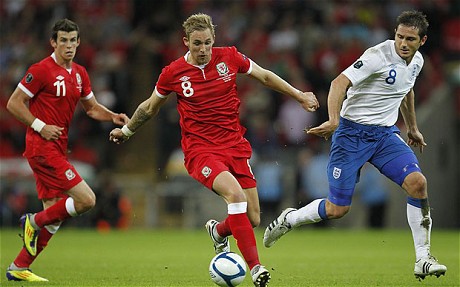
Wales’ best performance against England in twenty seven years.

On the face of it, that’s some claim to make, but, when you realise that we have only played England three times before last night since Mark Hughes’ goal at Wrexham back in 1984 was enough to secure a 1-0 win, then it’s not as impressive as it first seems. Indeed, Wales would not have had to play half as well as they actually did for such a claim to have some merit – we were absolutely awful in losing 2-0 at Old Trafford in 2004 and in Cardiff in March, while we didn’t reach any great heights during the 1-0 defeat at the Millennium Stadium in 2005 either.

As I alluded to in my review of the Montenegro game, it’s a Welsh trait (of which I’m as guilty as anyone) to go well over the top in response to good or bad performances by those representing our country and I suppose it needs to be remembered that England’s record at Wembley going into the game had been poor – they hadn’t beaten anyone there in over a year and yet they managed to see us off. However, you only need to go back less than five days to see what was being written and said before the Montenegro match and then put that against the last two performances to realise that the general feeling of renewed optimism and confidence has some justification to it.

Wales were good last night. They were certainly better than the Republic of Ireland team that luckily escaped from Moscow with a 0-0 draw against Russia a few hours earlier. The thing with the Irish though is that they are a team not used to losing and they were able to combine their international know how, some great last ditch defending and some awful finishing from their opponents (the chance the Russians missed in added time was almost as bad as the one Earnie missed last night with fifteen minutes left) to see things out. In my opinion, if Wales can acquire that international know how mentioned above, then I believe they have more to offer in most areas of the pitch than that Irish team did.

Jack Collison, finally playing his first "proper" match for Wales, one of a group of impressive young midfield players who look set to serve their country well over the next decade.

I say in most areas mind, because it appears to be the fate of those who follow the Welsh team that even our best sides still fall short in one of the key areas of the game or another. For example, that 1984 team I mentioned had Ian Rush and an emerging Mark Hughes in it and they’d soon be joined by Dean Saunders – the problem was though that we never really had a midfield good enough to fully exploit their talents. In the previous decade, the 1976 team that reached the last eight of the European Championship had the midfield, but, apart from an increasingly injury prone John Toshack, not the forwards to fire it to it’s true potential, while the side that reached the Play Offs for Euro 2004, were short of a really commanding keeper and, when Mark Delaney was missing, lacked true international quality at full back.

This team has a midfield that might well turn out to be the best I’ve seen represent us, while the emergence of Neil Taylor and Darcy Blake offers hope that we can become a decent defensive team as well – especially if Wayne Hennessey keeps on playing with the assurance he has shown for club and country over the last twelve months or so. However, I’m not sure where the goals are going to come from in the next few years. This isn’t just a knee jerk following last night’s nil – we’ve scored three in six matches in this qualifying group. To be fair, we look very dangerous going forward on Friday – Steve Morrison has made tremendous strides since he came into the Football League at a relatively late stage in his career and there might be a lot more to come from him yet, also, put Craig Bellamy in last night’s team and it immediately looks more threatening. However, by the time the players in their early twenties now reach their peak, Bellamy will not be the player he is currently (if he is still playing at all that is) and there seems to me little sign at the moment of a natural replacement coming through. For me, the big disappointment with the current crop of youngsters is that not one of the trio of Ched Evans, Sam Vokes and Simon Church, that looked so promising two or three years ago, has really kicked on. Church, who had an almost telepathic understanding with Aaron Ramsey in the Under 21 team, is the biggest disappointment for me – he seems to have recently been overtaken in the Reading pecking order by Hal Robson-Kanu who, at the moment, looks to be the best hope we have of unearthing that new striker we need.

Darcy Blake getting the better of Wayne Rooney - it was a fairly common occurrence last night with the City player being nominated as man of the match by some in the media.

Going back to last night, would we have caused England more problems with Gareth Bale attacking Chris Smalling on their right hand side instead of Ashley Cole on their left? I happen to think that we might well have done, but, just as against Montenegro, I’d prefer to concentrate less on the one thing Gary Speed, arguably, got wrong and more on the things he got right. For a start, the easy option for him would have been to bring James Collins back in after his suspension for Darcy Blake, but, recognising that England would not present that much of an aerial threat, Speed chose to keep things as they were and was rewarded by what was comfortably Blake’s best performance yet in a senior Welsh shirt. The City man was quick and assured in his defending (I thought he outshone his centreback partner in that respect) and, for someone who has been, justifiably, criticised by some for his use of the ball, he looked completely at home with the pass, pass, pass philosophy that Speed wants. On the subject of passing the ball, it takes a brave team and manager to go to the ground of a side rated as 7/1 on favourites and play like Wales did – there were periods, particularly after the goal, when England showed what they were capable of, but, generally Wales outpassed them and looked a composed and well organised outfit. Wales also seem to be good finishers of a game under Gary Speed – invariably, they look fitter than their opponents in the closing stages of games.

With regard to individual performances, there might not have been eleven displays as good as the ones against Montenegro, but Neil Taylor largely equalled the standard he set against Montenegro, while Blake and Chris Gunter improved on theirs. Andrew Crofts did not suffer in comparison to the highly paid “superstars” he was up against in the England midfield and while not as effective as he was on Friday, Bale showed why Fabio Capello changed his team and tactics to try and deal with him, However, the player who stood out for me was Aaron Ramsey. He was the youngest player on the pitch, but you would never have guessed that mind as he controlled things in the middle if the park. In the second half especially, he came so close to finding the pass that would unlock the England defence – for the first time since his return from injury I thought this was Ramsey back to his best.

So, a very promising couple of early season matches for Wales with many of the much hyped youngsters from the past five years or so showing the sort of ability they displayed at Under 21 level on the bigger stage – regarding the Under 21’s, I’m afraid they were beaten 3-1 in Montenegro (Jon Meades got his first cap after coming on as a sub for the last quarter of an hour) after scoring first in their Euro 2013 qualifying match. There were other City players involved in games last night – Don Cowie gave a typically hard working performance while playing the full ninety minutes for Scotland in their 1-0 victory against Lithunia and Filip Kiss came on as a sub for Slovakia Under 21’s in their 1-0 win in Kazakhstan, but Aron Gunnarsson, Dekel Keinan and Joe Mason did not figure in the squads for Iceland, Israel and Ireland Under 21’s respectively.

Posted in Wales | Tagged , | Comments Off on Wales’ best performance against England in twenty seven years.