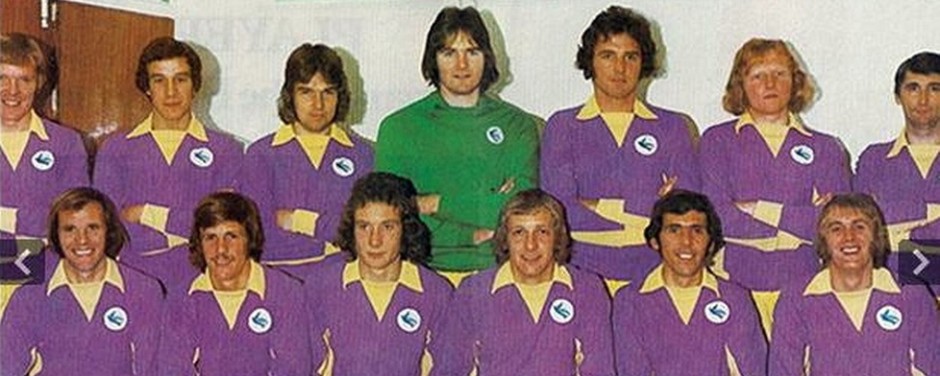
Seven decades of Cardiff City v Brentford matches.

It’s always tough to come up with questions from the 60s and 70s with Brentford because we only played them once during these decades, but here’s what I’ve managed this time – answers will be posted on here tomorrow.

60s. Born in a town which I think of as being archetypically Yorkshire, this forward began at a team in a distinctive kit that were a power in the land at the time. Despite a good goals return when he got his chance, he had to accept that he must move on if he wanted regular first team football and travelled south and west to a coastal city where he made a scoring debut against Ipswich. With a scoring rate of a goal every two games, his three years at his second club could hardly be called a failure, but they decided to use him as part of a player swap deal, so he switched to what might be called a dated exhibition centre in an eastern steel town. He didn’t do as well there or at an exotic sounding location near his birthplace, but he recaptured his scoring touch when he moved to club close to the one where he had enjoyed his best days. A scoring rate of better than a goal every other game persuaded Brentford to sign him, but he only stayed with them for a season before his final move saw him turning out for mischievous kids for two years. He called time towards the end of the decade on a career in which he managed just over one hundred and thirty goals from slightly more than three hundred appearances, but can you name him?

70s. Overseas players were nowhere near as common in the domestic game at the time this three times capped forward from a different continent but the same commonwealth made an impact. A so so introduction to first team football at Brentford was interrupted by the first of what turned out to be many injuries, but he enjoyed a prolific goalscoring phase on his return where he averaged nearly a goal a game over more than half a season. His form persuaded his former manager to pay £30,000 to bring him to a Fen land club on their way to their first promotion to the old Second Division. Two injury plagued years followed and it seemed he had left the British game for good when he returned home, but there was a second stay at Brentford which was short and not too sweet before he finished off in his native land playing in a city which had hosted the Commonwealth Games when he was playing in England – who is he?

80s. I help Bart to become five hundred game veteran.

90s. The club this defender began his career with may not have been as powerful then as they once were or would become, but it was still a notable feat to complete almost one hundred matches for them. After a loan spell with midlands song birds, he moved a long way south to a side which were on their way out of the First division and they did not return to it during his three years with them. Next up was a move four hundred and fifty miles north (but still not as far north as his birthplace) to a club often identified by something you’d buy from a cake shop where his most notable moment probably came when he suffered a broken nose following an altercation with a team mate who would go on to manage Scotland. He next played for midland thieves before ending his career with a season at Brentford as the decade was drawing to a close – who am I describing?

00s. Bird’s bar bill perhaps?

10s. He returned to this country for the start of the season after a spell in the Netherlands and when he scored for his current, League One, club in August, it was his first goal since he scored for Brentford against us at Griffin Park, can you name him?

20s. He began his career with a club that play in pink and blue, moved to a team whose proposed new stadium will be made, almost entirely, of wood and then to the birthplace of, possibly, cricket’s most famous umpire – he has also scored for Brentford in this decade, who is he?

Answers.

60s. Barnsley born Joe Bonson started off with Wolves, but made a name for himself at Cardiff where he scored thirty seven times in seventy two appearances. In 1960 he moved on to Scunthorpe United’s Old Show Ground in a swap deal involving Peter Donnelly, before a brief spell at Doncaster Rovers’ Belle Vue stadium. In 1962, he returned to south Wales and managed forty seven goals in just over eighty games with Newport County and subsequent spells at Brentford and Lincoln saw him scoring at a healthy rate until his retirement in 1967.

70s.  Canadian international Gordon Sweetzer scored twenty three times in twenty eight matches during the 1977/78 season and, within a few months, he had reunited with former Brentford manager John Docherty at Cambridge United, but injury meant he played less than ten league matches for them. Brentford resigned him after a decent spell at Toronto Blizzard, but he only scored once and ended his career at Edmonton Drillers in 1982 at the age of twenty five.

80s. Phil Bater.

90s. Graham Hogg moved from his native Aberdeen to sign for Manchester United in the early eighties and made himself a fairly regular member of their defence until 1988 when he was signed by Portsmouth following a loan spell at West Brom. His next move took him over the border to Hearts where he found himself in a spat with team mate Craig Levein during a pre season friendly which saw him suffer a broken nose. In 1995 he signed for Notts County and three years later he moved to Brentford for a short time.

00s. Jay Tabb.

10s. Sullay Kaikai scored twice against us on Boxing Day 2016 to earn Brentford a 2-2 draw while on loan from Crystal Palace. After a short spell with NAC Breda, he signed for Blackpool at the start of this season and his goal against Gillingham for them on 20 August was his first one in over three and a half years.

20s. Ethan Pinnock played over one hundred and fifty times for Dulwich Hamlet before signing for Forest Green Rovers in 2016. Barnsley paid a reported £600,000 for him a year later and last summer he moved to Brentford for £3 million – he scored his first goal for his new club in a 1-1 draw at Birmingham a fortnight ago.


Posted in Out on the pitch | Tagged | 1 Comment

All so predictable as Cardiff wonder where the next goal is coming from in Tomlin’s absence.

I usually try to make these post match pieces a minimum of one thousand words long, but I think I may struggle to manage that tonight because I honestly do not have much to say that doesn’t fall into the bleeding obvious category about Cardiff City’s 1-0 home defeat to Nottingham Forest.

In many ways, it was a case of for Forest, read Stoke because the clear deficiencies laid bare by the absence of Lee Tomlin on Saturday were there again for all to see. The frustrating thing is that you don’t need to be a genius to know what would happen as soon as Tomlin wasn’t available because the rest of the squad are just confirming what has been clear all season – there is a lack of creativity, incisiveness and decisiveness in the final third which is hardly helped by not having a striker that is convincing in front of goal. Therefore, I repeat something that I said on Saturday, it should never have been allowed to get to the stage where an injury to one member of the squad means such a drastic reduction in its capacity to do the unexpected or provide that X factor that provides something out of nothing.

Although I was saying that tonight was a rerun of what happened on Saturday, that’s not quite true, because this was definitely better than the limp showing at Stoke in terms of attitude and attacking intent, but it was still hard to escape that feeling that the belief wasn’t quite there that the team could unlock defences without their most creative player.

Maybe that’s a bit harsh on reflection, because there wasn’t really a lack of players willing to take on responsibility when it came to that final ball, incisive cross or shot from distance, but, sadly, the quality was lacking – the word that kept on coming into my head as I watched us huffing and puffing to no real effect as we put Forest under pressure in the search for an equaliser was conviction.

I’m afraid there was a lack of it in almost everything we tried to do in the final third, whether it be passing, crossing or shooting.

When it came to the latter, the only shot I can remember from us that was truly struck in the manner that the player was aiming for was a twenty yard effort by Robert Glatzel that provided Forest keeper Samba with one of his few awkward moments of the night as he dived to turn the ball aside for a corner.

As for the rest of our goal attempts, they weren’t all totally undermined by poor technique, but many of them were – too many for a side which seriously believes it can be involved in the end of season hunt for that final promotion place.

At least there was one shot that almost brought about the desired effect, that was not true when it came to crosses – I did not see one which seriously inconvenienced the Forest backline and keeper, they were of a generally poor quality and gave the impression that they were just being aimed in the general direction of a blue shirt.

With the delivery from free kicks and corners also being pretty ordinary, City, as they do too often lately in home games became over reliant on Will Vaulks’ long throws, but even they were not as effective as normal – something which a resolute and well organised Forest defence should be given credit for I suppose.

Although Junior Hoilett did some good things in defence and always showed for the ball in attack, I I do find myself wondering why wingers are considered automatic selections under our last two managers when they too often prove to be utterly ineffective when it comes to crossing and cutting in from your wing to shoot.

On the other wing, the best word to describe Josh Murphy’s contribution is exasperating. In the last month or so, he has upped his game and, in a different way to Tomlin, suggested he could be a catalyst for the lift off the team has been needing from the start of the season. Unfortunately, tonight was more like the pre Christmas Murphy – I hesitate to say he wasn’t trying, but to use a term that we hear an awful lot of these days, his body language was terrible.

Murphy had already lost a ball weakly in midfield in the very early stages of the second half to set Forest on a dangerous attacking raid, when he  erred again in the same manner to present Forest with a chance to counter attack from around the halfway line and Lewis Grabban and Tiago Silva combined with such good effect that the latter was soon celebrating a well taken and decisive goal.

Murphy’s final contribution was.to send in a free kick from a dangerous area out on the left so poorly that it barely ever got off the ground and so it was no surprise that, just as against Preston shortly before Christmas there were cheers when his number was held up within seconds as one of those to be withdrawn.

With both wingers under performing and Callum Paterson quiet as he returned to his highly unorthodox interpretation of the modern day number ten roles, the bulk of the attacking responsibility fell on Glatzel who responded to a surprise recall to the team after having not been used at all from the subs bench in recent games with one of his better showings in a City shirt as he showed a strength which has not been too apparent up to now – his hold up play was good and he won the team a lot of free kicks as well because of his ability to keep the ball just as he looked to be on the point of losing it.

Of course, that shot I mentioned apart, Glatzel never really looked like scoring because that is the lot of a striker at modern day Cardiff City – given what’s behind him in terms of inventiveness and flair, you’d have to be another Harry Kane to get to ten goals a season for us!

Glatzel was one of the night’s plusses, as well as Alex Smithies who was worked a lot harder than his opposite number, a fact which tends to prove that Forest were, by not too big a distance, the better side and, although he didn’t do anything brilliant, I thought Dion Sanderson, in for Jazz Richards, added pace and some urgency to our attacking game on his debut. Certainly, I don’t believe he deserved to be taken off in a substitution that I thought smelt of management by numbers – you know, the youngster has to be taken off no matter what and I thought there was an element of getting your just deserts as Sanderson’s replacement, Leandro Bacuna was booked within thirty seconds of coming on as he struggled for defensive pace in a way that the man he had come on for may well not have done.

A word to for Joe Ralls who came on for the last twenty minutes and definitely improved the team’s level of performance – he really should be in from the start every week if available.

One last thing, Murphy’s miserable showing did include one major talking point when he went down in the penalty area under challenge from Forest’s Matty Cash just before half time for what to me, admittedly from the opposite end of the pitch, seemed a clear penalty, but referee Steve Martin, another weak and inefficient official to follow on from John Brooks in the Wigan game, thought otherwise. .

Well, that’s it, sorry for a shorter reaction piece than normal, but it’s hard when it’s so clear what is wrong – if I’d done, say, another thousand words, I would only have been trying to find different ways of saying the same thing and I fear this is going to be a problem I’m going to have to wrestle with for the rest of the season.

Posted in Out on the pitch | Tagged , | 6 Comments