Halloween horror for Hull in Toshack’s Ninian Park swansong.

As a rule I tend to go for the less obvious matches when selecting which game against future opponents I will look back on, but, in the week that the best young player I have seen play for Cardiff, almost certainly, made his last home appearance in a City shirt for the foreseeable future, I thought I just had to go for the game against tomorrow’s opponents in which the local player who achieved the most after leaving us played his last ever home match for City.

Aaron Ramsey may have more talent and potential than the young John Toshack did, but Rambo will do very well to achieve what Toshack has done over the past forty five years. The fall out from his, largely unsuccessful, stint in charge of the Welsh team as well as his Swansea City connection makes Toshack an unpopular figure with many City fans now, but that was not the case just over forty years ago when his sale to Liverpool for £110,000 (a record signing for them at the time) had a devastating effect – it left supporters angry and deflated, significantly harmed our promotion chances and, worst of all, set in motion a long period of decline at Cardiff City that has only been arrested in the last decade.

From the moment he made his City debut as a sixteen year old in 1965, John Toshack was always being linked with “bigger” clubs, but, until the Autumn of 1970, they tended to be middling to small First Division sides. For example, Leicester City (who were relegated in 1969) were a name that often cropped up, while the player turned down a move to Fulham in 1968 for a fee of £75,000 – the fact that Fulham were playing in the Third Division by the time he left City proves that Toshack got that one right, but it also shows that the Cardiff Board of Directors (under Chairman Fred Dewey) were eager (or should that be over eager!) to cash in on their young striker.
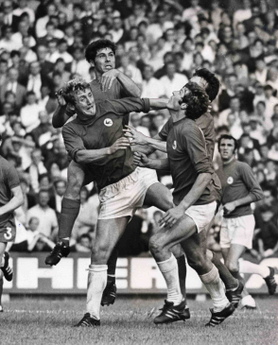
John Toshack in action for City alongside his long time striking partner at the club - the late Brian Clark.

From memory though, there was not too much transfer speculation floating around when promotion rivals Hull City came to Ninian Park on 31 October 1970 – the goals had dried up for Tosh in the second half of a 69/70 campaign which had seen him dropped to the substitute’s bench for some of it’s final fixtures and he had only scored five league goals in the new season at that time. Although their away results had kept them up amongst the contenders at the top of the table, City, not helped by a series of costly blunders by new keeper Frank Parsons, had been having a moderate time of it at Ninian Park with just one win to show from their first six league games there. However, a superb performance in beating FC Nantes 5-1 in the European Cup Winners Cup (Toshack scored twice) had restored confidence and, three days before Hull’s visit, Tosh’s goal had been enough to secure an uninspiring win over lowly Portsmouth that lifted us up to third in the table.

One of the sides above us at that time was Hull City. Under new player/manager Terry Neill, they had made a very strong start to the season on the back of a run of six wins in seven games during which they had let in just the one goal. With only nine goals conceded in fourteen matches, you would have thought that ex Arsenal centre half Neill had few defensive problems, but, perhaps mindful of the 3-0 and 6-0 beatings Hull had suffered in their two previous visits to Cardiff, he tinkered with his team to the extent that six of them could be called natural defenders.

Within a quarter of an hour, Toshack had Neill wishing he hadn’t been so cautious – an early header had us 1-0 up and when Tosh stabbed in a superb cross from the right wing by Don Murray of all people, City were well on their way to climbing above the Humbersiders in the table. A header by Geoff Barker (who was, ironically, one of the extra defenders brought in by Neill) got Hull back into the game just before half time, but they were then taken to the cleaners in the second half by a City performance wholly out of keeping with the dank, wet conditions.
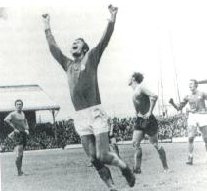
John Toshack's last goal for Cardiff City - Tosh celebrates as his superb volley completes his hat trick.

If Toshack’s first two goals had been examples of a striker being in the right place at the right time, his final goal for the club on the hour mark was something different as he took Bobby Woodruff’s flick down and then showed an example of his often under rated technique by crashing an angled volley into the roof of the net from about ten yards to complete his hat trick. City were rampant by now and midway through the half they went three goals clear when Toshack glanced on a Peter King corner for Ian Gibson to score a very rare headed goal from point blank range.

I can remember Hull’s goalkeeper Ian McKechnie being a chirpy character who often had a smile on his face, but, having conceded nine goals in his two previous games at Ninian Park, he wasn’t seeing the funny side of it that afternoon. McKechnie had blasted the ball into the crowd on the Grange End in frustration when Toshack’s third goal had rebounded straight back to him off the stanchion of the goal and his mood wasn’t improved five minutes from time when he allowed Leighton Phillips’ shot from outside the penalty area to squirm under his body for our fifth.

There could easily have been more City goals, but 5-1 was a result which made many in the country sit up and take notice. Unfortunately, much the same could be said about Toshack’s hat trick – perhaps Liverpool had been tracking him anyway, but those three goals must surely have brought things to a head for them? As it was, the transfer which shaped the destiny of the club did not take place for another ten days or so. Toshack played the following week in an excellent 1-0 win at QPR, but was then sold shortly after that – this time the player had no doubts about moving and, given how things worked out for him, who can blame him (he was scoring in a Merseyside derby within a fortnight)?
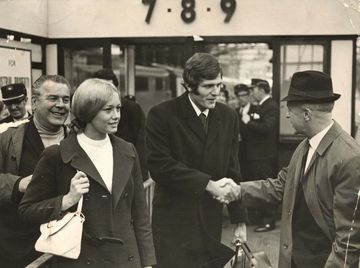
John Toshack and his wife Sue meet Bill Shankly at Lime Street station prior to him signing for Liverpool.

Looking back at it now, the worst thing that could have happened for City was that they crushed a woeful Blackburn team 4-1 at Ninian Park in their first game after the transfer – Peter King scored within forty five seconds and you get the feeling that this game persuaded the Board that they could take their time bringing in a replacement for Toshack. One win in the next six matches (three of which were lost) showed this was not the case and, by the time they finally stopped haggling with Sheffield Wednesday about a price for Alan Warboys and actually got around to signing him, we had dropped down to fifth place.

During January I heard people compare the situation we find ourselves in now with Jay Bothroyd to when we sold John Toshack, but, to me, the two cases are entirely different. If Jay had been sold in January, it would have been against a background which has the player leaving for nothing in the summer if he does not sign a new contract with us and, although that would have been a big disappointment in terms of our chances of going up, it would make financial sense. However, the current Board took the decision they weren’t going to sell Jay despite what the, surely inevitable, consequences of us failing to go up might be – back in 1970, City were always going to get a fee for Toshack, but, seemingly, the Board could only think in terms of clinging cash registers (Liverpool manager Bill Shankly later said that his club had been willing to pay twice as much as they actually did for Toshack).

31 October 1970

Cardiff City 5 Hull City 1

City Eadie; Carver, Murray, Harris, Bell; Gibson (1), Sutton, Phillips (1), King; Woodruff, Toshack (3); Sub (not used) Clark

Hull; McKechnie; Beardsley, Neill, Simpkin, DeVries; Jarvis, Wilkinson, Houghton, Barker (1); Wagstaff, Pearson; Sub (not used) Butler

HT 2-1

Att. 21,856


Posted in Memories, 1963 - 2023 | Tagged , | Comments Off on Halloween horror for Hull in Toshack’s Ninian Park swansong.

Our most satisfying win of the season so far?

I think it is now generally accepted that the atmosphere at home games recently has not been as good as it was last season and now there have been some saying that the large contingent of City fans at Nottingham Forest on Saturday were quieter than normal. Maybe I’m wrong, but my explanation for that is that, collectively, there is a “now or never” feel about this season because the players brought in since August have, on paper at least, given us our best chance of playing top flight football in nearly fifty years. The stakes have been raised that bit higher and supporters have become nervous on the back of that because they don’t want to contemplate what failure might mean.

The trouble is though that for most adult supporters, failure has been a constant companion throughout the time they have followed the club. Although long term fans will recognise that these are, relatively speaking, great times to be a City fan, the truth is that even the youngster who has come on board on the back of our FA Cup run in 2008 has, when it really comes down to it, only known failure so far in their time following the club. It is hardly surprising then that, collectively, we tend to be a bit of a pessimistic bunch and I reckon that feeling of “something is bound to go wrong in a minute” has adversely effected the atmosphere this season.

This attitude also shows in people’s feelings towards the team – there is a perception that the players will fold on the really big occasion (I’m as guilty as anyone of this – I said as much in my piece on here after the Forest match). In saying that mind, I do genuinely believe that there are questions about the balance and effectiveness of the squad and of the manager’s ability to get things right tactically on those really big occasions. If it is right to question things rather than go down the blind loyalty route though, then it is equally correct that when the team, management and coaching staff get things right, as they did last night, then their efforts should be applauded – a few of us should, maybe, concede that we haven’t got as bad a team or manager as we sometimes think we have and that they are deserving of better support than they have been getting lately.

Michael Chopra's vitally important goal puts us 1-0 up - it looked simple, but it was an example of why he is the best natural finisher at the club.

I thought the atmosphere last night got better as supporters gradually recognised that their team was getting the better of yet another set of opponents who came into a game with us on the back of their best run of form of the season. Perhaps it was out of a desire to quieten the crowd early on that Leicester switched to a 4-5-1 formation last night, but, if it was, their scouts should really have told them that there was no need to do that currently – being quiet comes naturally to us lately!

Whatever the reasoning behind their thinking was though, after a fairly even start, Leicester began to take command in the middle of the park in  a manner which City fans have become too familiar with over the past couple of seasons. During these periods when City are being pushed back constantly, it is easy to forget that so much of the visiting side’s dominance is down to the fact that, for right or wrong, Dave Jones is nearly always happy to start off with a central midfield which has one man less than our opponents do in that area. Quite often, Dave Jones’ approach pays off and 4-4-2 beats 4-5-1, but, when the opposition have players in the middle of the park who are not careless with their passing, it becomes very hard to get a foothold in that, very important, area of the pitch. When that happens, it doesn’t automatically mean that our midfield is “crap”, it just means that our four good players are being bettered by their five good players as we look to take advantage of our numerical superiority in other areas of the pitch.

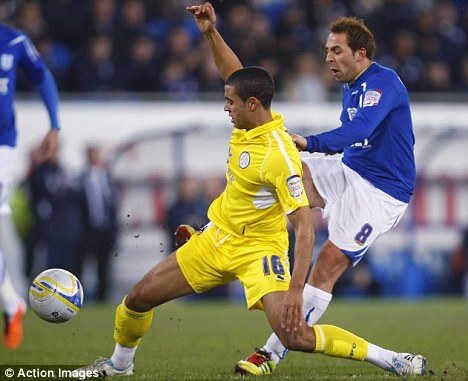
That was what happened for the first goal when Jay Bothroyd, the man who would have been our lone striker in a 4-5-1, got involved out on the right hand touchline before Paul Quinn created a bit of room for Seyi Olofinjana with a neat pass. Olofinjana (who, again, showed his improved form of recent home games) was allowed to burst into the penalty area where he was able to find our second striker unmarked twelve yards out and Michael Chopra (whose little backwards run, when so many others would have gone forward, created the space for himself) did the rest. I don’t think that goal would have been scored by a team playing 4-5-1 if their striker had drifted out wide like Bothroyd did, but, having managed to get beyond the opposition’s midfield five, we had the extra striker in there to finish things off.

There is no point denying that the goal came against the run of play and for much of the time after that, the game resumed it’s previous path with us being pushed back under Leicester pressure, but, whereas  we looked happy for this to happen against Burnley when we were 1-0 up last week, this time around we seemed less passive and more willing to push forward in midfield when we had the chance. That said, I’m sure that I would have been feeling that the half time scoreline was an unjust one if I were a Leicester fan and, for a short while, it looked like it would be a very long second forty five minutes indeed as Tom Heaton saved well from Richie Wellens and Paul Gallagher fizzed a free kick just wide. However, the game was then turned on it’s head by a class goal from a class player.

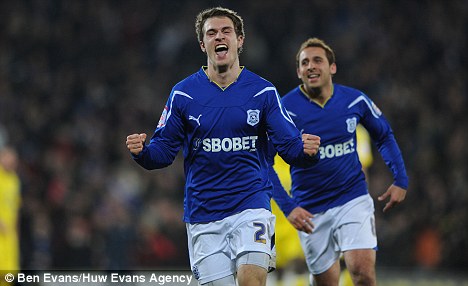
Aaron Ramsey celebrates his beautifully worked and excellently finished goal.

Being sat so far away from the dug out, I couldn’t tell whether Steve McPhail was going to come on for Michael Chopra anyway or whether it was as a result of us going 2-0 up. Either way though, it turned out to be exactly the right decision. While it has to be accepted that a few Leicester heads dropped after Aaron Ramsey’s goal, what we saw after that was our five in midfield getting the better of their five. One fine Kevin McNaughton tackle apart, Leicester never really threatened in the last forty minutes and a third City goal always looked the more likely as we completed what, for me, was just about our most satisfying win of the campaign – there was even a late booking for Peter Whittingham to satisfy the “get stuck in” merchants!

It was a night where every one of the fourteen players used could look back on their contribution with some satisfaction. To name a few individuals though, in his fifth match for us Dekel Keinan again showed he has improved our defence with another effective and unfussy display and it was good to see Kevin McNaughton get involved so directly in creating a goal (the quality of his pass does make you wonder why it doesn’t happen more often mind). Finally, I thought Chris Burke, who came very close to getting that elusive first goal since August, looked more like his old self when he came on.

However, if you talking about man of the match candidates then there were two for me with the two Arsenal loan players battling it out for that honour. Given what Arsene Wenger has been reported as saying, it looks like Aaron Ramsey has played his last home game for us and, if that is the case, what an appropriate send off it was. His goal, courtesy of a typically calm finish, was the icing on the cake of a performance which served as a reminder to the fact that he really is the complete central midfield player – he was the disciplined team man in the first half, a goalscorer early in the second and then he showed how effective he can be playing in the hole behind the striker. Dave Jones thinks Rambo isn’t quite ready for the Premiership yet and maybe he is right, but last night he was too good for the Championship’s form team.

As for Jay Emmanuel-Thomas, I mentioned after the Watford game that I didn’t think he had “punched his weight”, but that wasn’t true last night as he used his height and power to good effect while also providing  plenty of evidence of his ball skills. His passing was better too, with the ball he played to McNaughton in the build up to the second goal being an example of this and, for the first time, it was possible to see a few clues as to why Arsene Wenger has talked about him in such glowing terms in the past. I noticed that the Man Of the Match award announced after the game went to Ramsey and I have no real quibble with that, but I think I would have given it to JET because that display offered hope that he can play a big part in our run in, something which, unfortunately, I don’t believe Rambo will be doing.

Posted in Down in the dugout, Out on the pitch | Tagged , , , | 1 Comment