R.I.P. Jimmy Andrews (1927-2012)

Following on from the loss of a City manager from the nineties in Eddie May back in April, one from the seventies left us on Wednesday when Jimmy Andrews died after a long illness at the age of 85. Andrews was born in Invergordon in Scotland  just about three months before City won the FA Cup and began his playing career at Dundee just after the end of the Second World War. His performances on the left wing eventually earned him a move to West Ham when the London team paid a fee of just under £5,000 to secure his services. Andrews spent five years at Upton Park, scoring twenty one times in one hundred and eighteen appearances, before moving on to neighbours Leyton Orient before finishing his career at Queens Park Rangers.

By the time Jimmy Andrews retired in 1962, he had scored a total of forty nine goals in two hundred and sixty two appearances for his four clubs, but , having been part of a group of players who used to meet up after training at West Ham to discuss all aspects of the game, there was never much chance that he would be lost to football once he stopped playing. In fact, he was soon working as a youth coach at Tottenham and then as Tommy Docherty’s assistant at Chelsea before having his first stab at management when he returned to QPR for a short spell in 1965.
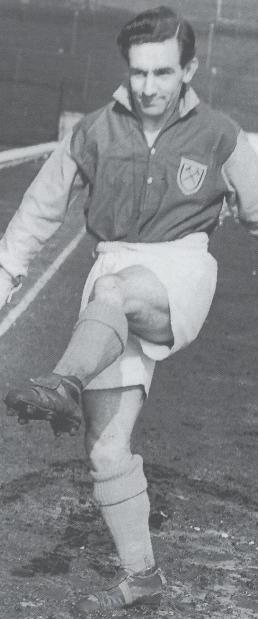
A rare photo of Jimmy Andrews the player.

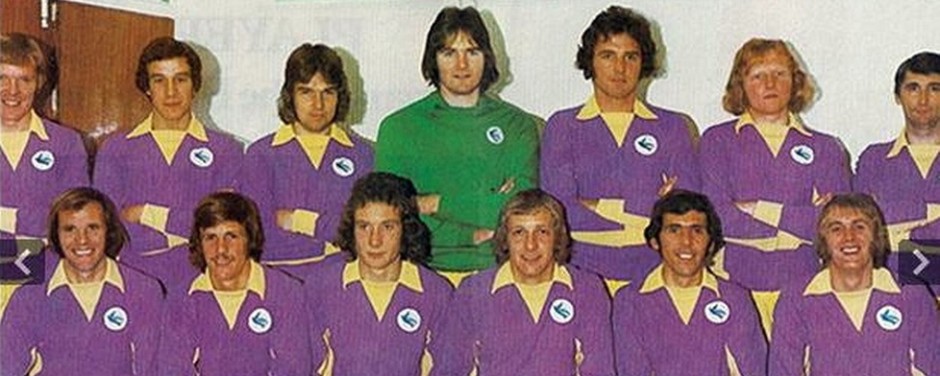
Andrews spent a while out of the game after that, but his ex West Ham colleague Frank O’Farrell appointed him as his Assistant after accepting the manager’s job at Cardiff in November 1973. O’Farrell didn’t stay long at City and had gone off to manage Iran before the season was out, but Andrews  didn’t go with him and was given the manager’s job (initially on a caretaker basis). The Scot managed to keep City up and was rewarded by being given the job on a permanent basis – in truth though, Andrews had been handed something of a poisoned chalice and, after years of battling against the drop into the Third Division, the team succumbed to the inevitable in his first season and so Cardiff faced up to lower division football for the first time in nearly thirty years for the 1975/76 season.
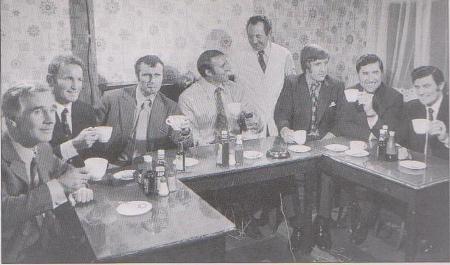
Jimmy Andrews seen with some of his West Ham team mates, most of whom went on to become successful managers – from left to right, Jimmy Andrews, Dave Sexton, Noel Cantwell, Malcolm Allison, John Bond, Frank O’Farrell and Malcolm Musgrove.

I had been supporting the club for twelve years at that time and, apart from those three seasons between 1968 and 1971 where we almost made it into the old First Division, had got used to watching City teams struggle near the bottom of the table for most of the time. Therefore, it was fantastic for supporters around the same age as myself to watch a successful, and better still, entertaining Cardiff team challenging at the top of the table throughout most of the season before finishing with a charge which saw them concede just one goal while winning six and drawing three of their last nine games to secure the second promotion spot behind Hereford United. Jimmy Andrews deserved tremendous credit for City’s promotion that year because he rebuilt the side on the usual Cardiff shoestring budget by blending the likes of Mike England, Doug Livermore, Alan Campbell, Tony Evans and Adrian Alston with  John Buchanan, Albert Larmour, Phil Dwyer, Clive Charles and Willie Anderson (all of whom performed better than they had done previously) to create a side which were too good for most of the opponents they came up against.

Just as before though, City found life in the Second Division difficult on their return and they only stayed up in 76/77 courtesy of a nail biting last game draw with Carlisle, but at least Andrews could point to a great FA Cup run which saw marvellous wins over Spurs and Wrexham that featured prominently on Match of the Day before being unluckily beaten 2-1 by Everton in the Fifth Round. Another season of struggle followed and when City found themselves down near the bottom again in November 1978 (after Andrews had been given a fortune to spend, by Cardiff standards, during the summer), the Board decided to terminate his contract after a 4-1 home defeat by Charlton. Andrews continued to live in South Wales for the rest of his life and did some scouting work for Southampton, but, apart from that, he had finished with the game and it’s a sobering fact that you would have to be into your 40’s (at least) to remember his time at Cardiff now.

Often described as too nice a man to succeed in football management, Jimmy Andrews didn’t really prove that description wrong during his time at Cardiff because the brutal truth is that he only had one good season in his four at the club. However, those of us who can remember Tony Evans walking on water, Adrian Alston shooting from the halfway line against Brighton, Willie Anderson reducing Third Division full backs to gibbering wrecks and 5-2 wins over Peterborough.1-0 thrashings of Crystal Palace and a crowd of 35,000 (that’s the official figure!) for a home league match will remain forever grateful to the man who provided many of us with their first City promotion – thank you and rest in peace Jimmy Andrews, my commiserations to your family and friends.

 

Posted in R.I.P. | Tagged | Comments Off on R.I.P. Jimmy Andrews (1927-2012)

A new low.

Generally, the reaction to Friday’s defeat by Belgium in Wales’ first game in their qualifying pool for the 2014 World Cup was fairly positive. Okay, the team rarely looked like breaking their scoring duck under new boss Chris Coleman, but they played about three quarters of the match with ten men, got virtually nothing from an inept referee, defended pretty well and worked really hard for the cause. I said on here that I felt sorry for the team after their loss and was reluctant to criticise the man in charge – what a difference three days makes!

If it could be argued that the Belgium match represented a case of losing with honour, then last nights’ 6-1 hammering at the hands of Serbia was definitely a defeat with dishonour.  I can remember heavier Wales losses (7-1 in Holland in 1996 springs to mind), but I don’t think I can remember a more humiliating defeat than this one except for, possibly, the 5-0 thrashing in Georgia in November 1994 – when you consider though that Serbia had won one out of their last eleven matches before last night and had only scored three times in their previous nine though, I think the nightmare in Novi Sad outweighs the trouncing in Tbilisi in the embarrassment stakes.

That said, speaking as someone who  can recall the days when the old unified Yugoslavian team was sometimes labelled “the Brazil of the Balkans” because of the very high level of skill shown by players from that part of the world, there is no way that any of the new countries from the area which have emerged since the disintegration of the Eastern bloc should ever be underestimated. However, the “Brazil of the Balkans” did sometimes show a tendency to fold when the pressure was on and you often got the impression that the whole did not add up to the sum of it’s parts (the ethnic conflicts which burst into bloody violence in the 1990’s almost certainly played their part in Yugoslavia’s relative under achievement as well).

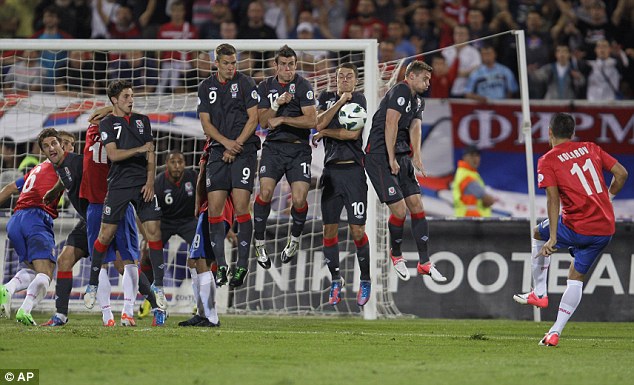
The start of a rout – Aleksandar Kolarov curls a free kick, needlessly conceded by a striker playing left midfield, into the Welsh net to put Serbia 1-0 up.

For a few short moments last night, it appeared that Wales were up against a team wracked by self doubt after their miserable run of results – without creating anything dangerous (has Chris Coleman’s side done that in any game yet?), Wales were definitely the better side for the first ten minutes or so and something more than the draw, which I saw as the best outcome we could hope for last night, looked a possibility. Sadly, any self doubt that Serbia might have been suffering from soon disappeared when they saw what a shambles they were up against – Wales’ complete inability to clear their lines when put under their first period of pressure in the game culminated in a panic stricken Darcy Blake slicing a hacked clearance just wide of his own upright and, from then on it was downhill all the way.

From that moment, it was one way traffic towards the Welsh goal apart from an interlude of about a minute when Gareth Bale at least managed to score with a superb free kick totally out of keeping with the rest of what his side produced for about 95% of the game. Credit where it is due, Serbia produced plenty of examples of the high level of technical ability I mentioned earlier and the way they hunted in packs to close down their opponents when Wales were in possession was impressive, but it was hard to avoid the impression that it was as much a case of us making them look good as it was us coming up against a team that it going to make a major impact in Brazil (I’d still back Belgium and Croatia to qualify from the group). In saying that though, it should be emphasised that this certainly wasn’t a case of everything the opposition tried ending up in the back of our net (as happened in another Welsh horror show, the 5-1 home loss to Slovakia in 2006) – the BBC is reporting that Serbia had nineteen shots on target to our two (I’m still trying to recall our other one!) and the margin of defeat could, and probably should, have been greater than five goals.

I’m no fan of the blame culture which exists today, but when a team goes from being judged the most improved in the world by FIFA to the no hopers we saw last night (and in an atrocious performance against Bosnia a month ago) in less than a year, then it’s impossible not to start asking who is responsible. For me, there is no single person or body who should carry the can and, in the interests of fairness it has to be said that the whole of Welsh football, which appeared to be heading in the right direction so recently, received a blow which anyone would struggle to recover from completely when Gary Speed died (especially in the manner he did).

The game’s administrators were all of a sudden faced with decisions that they must have thought would not need to be tackled for a couple of years at least, but it does need to be said that the evidence is growing that they made a complete mess of what were awkward issues. When someone leaves any organisation that had been performing well, it seems to me that the sensible option would be to try and maintain a degree of continuity – the fact that we now only have Osian WIlliams in place from the Speed regime at senior and Under 21 level says all you need to know about the lack of continuity in the management and coaching of the players who will be making up the Welsh team for the foreseeable future. Brian Flynn was a much respected and, by Welsh standards anyway, successful overlord of youth football up to Under 21 level and yet he was allowed to leave and, although Raymond Verheijen might not be an easy man to deal with, he was effective, the players seemed to respect him and it’s impossible to deny that he has been right in nearly everything he predicted for Welsh football without him and Gary Speed. Verheijen might not have stayed with Wales anyway, but you can’t help thinking that the FAW weren’t too unhappy to see him go.

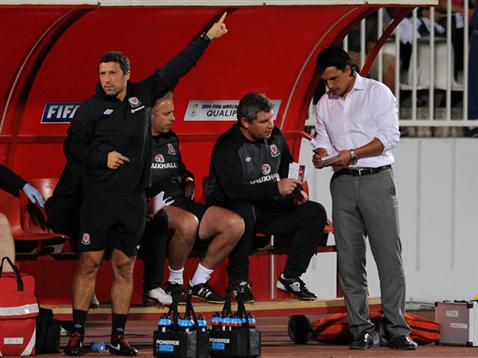
Chris Coleman and his staff try to keep track of the score.

The players also have to take their share of blame – again, it must be really tough for a lot of them to lose the manager they, obviously, admired and respected so much in the manner they did, but that was simply not good enough last night. I’m not going to talk about individual performances because I’d be here for ages, so all I’ll say is that the most positive slant I can put on what we saw from the Welsh team against Serbia is to say that some of them were not quite as awful as others (most of whom were ex City players). All six goals came about because of poor decision making and I’m doing Sunday morning footballers a disservice when I say that the defending for goals two through to five was of a parks football standard. Those players owe the Welsh supporters (especially those who were actually there to watch the massacre) a big performance against Scotland in a few weeks time. We know our team aren’t world beaters and there were quite a few absentees last night, but eleven out of the fourteen players used have played for Premiership clubs in the past year – even if some of us don’t believe the hype about the Premiership being the best league in the world, that’s still no excuse for the degree of ineptitude we saw from what are supposed to be the country’s best players.

Finally, we come to the manager (and the coaches he has appointed). I’ve already mentioned that Chris Coleman has had to deal with a lot of players pulling out of the squad and it has to be said that one with Hennessey, Taylor, Bellamy, Ledley, Collison, Crofts and, even, Collins in it would be quite a bit stronger than the one he had to work with against Serbia (you have to wonder just how fit Allen and Vaughan were as well). To be honest though, have we seen anything from the manager so far to indicate that our position would be any better (apart from having a slightly improved goal difference) than it is now if all of those players had been available? The biggest indictment of Coleman’s management for me is that in four games so far (I’ll be charitable and forget about the 1-0 defeat to Costa Rica), we’ve barely had an attempt on goal – we just don’t look like we can string three passes together, let alone construct a move in open play that causes our opponents a problem, and are increasingly looking to “get it up to the big man” as our main attacking ploy.

I mentioned on a messageboard this morning that, ordinarily, it would be ludicrous to call for a change of manager after he had been in charge for just two competitive matches, but I think this is a time to make an exception to that rule because everything we’ve seen so far very strongly suggests that Wales’ boss is turning good players into poor ones, what was a confident, improving team into one that is totally devoid of belief where it’s it’s hard to recognise any coherent ideas amid baffling selections and tactics – it”s hard to avoid the feeling that, where there was once a degree of sophisticated and progressive thinking, footballing dinosaurs have now taken over.

Posted in Wales | Tagged , | Comments Off on A new low.