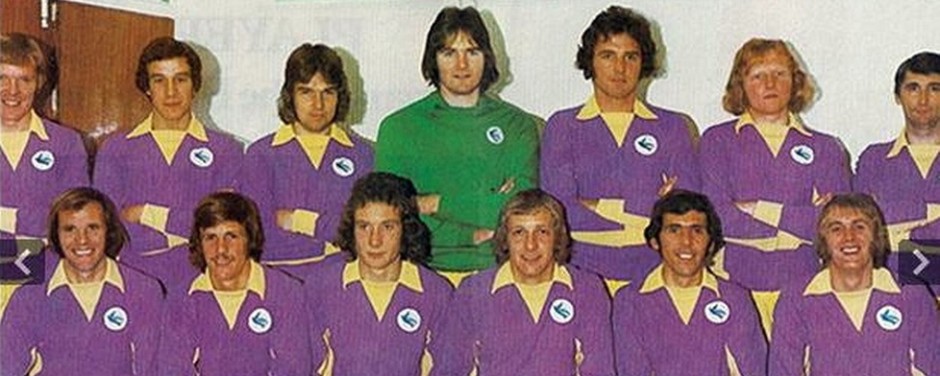
Six decades of Cardiff City v Sheffield Wednesday matches.

Questions going back to the sixties on tomorrow’s opponents – I’ll post the answers on here either tomorrow evening or Monday morning.

60s. This defender started off with his hometown, non league, club who play at a ground better known for another sport. Refusing to sign for local rivals until he had completed his A levels, he followed the manager who wanted him, who had just moved to Sheffield Wednesday, after he had passed his exams. Although he did play First Division football at Hillsborough, he was always seen as cover for the first team and left them after four years, having featured less than fifty times. He played more than four times as many games for his next club, who had the biggest pitch in the country as a claim to fame, a ground which sounded distinctly French and not a great deal of success. He did better at his final club where he played under a future England manager at a ground which has a stand now named “Poacher’s Corner”.

Ending a pretty modest playing career in 1977, he did better in management, especially at his first club where he enjoyed a record breaking winning run on the way to one of two promotions he achieved. Getting his chance in the top flight, the fact he stayed in post for three and a half years tells you he wasn’t a failure, but his style of play wasn’t popular with fans and a somewhat fraught relationship with the club’s talisman didn’t help his cause either. His final job in management was a two year spell alongside a river, can you name him?

70s. Can you recognise this player?

Educated at Anfield Comprehensive School, this winger had a short, unproductive, spell by the Lancashire sea side before dropping into non league football, Signed by Wednesday at the start of the decade, he quickly broke into the first team and, although it was a club in decline then, he was generally reckoned to be one of the best players in what was a poor team (and he could at least point to having played against Pele in his time with them). Having played for the newer version of his second club during his non league days, his form earned him an upwards move to the original version after more than one hundred and fifty games at Hillsborough. Again by the seaside, he didn’t always play, but did score some important goals and then left after a season to see out his career in his native county. He spent two years at each of his last three clubs – the first being a team that a famous plumber once played for, the second the residents of a stretch of grassy, open, uncultivated land and the third a side that were much in the news during the summer and early autumn for the wrong reasons.

80s. Inept sounding lawman features in Cardiff v Sheffield Wednesday match?

90s. Tangled leg joins men to produce a goalscorer.

00s. An England international remembered for the “interesting” thing he was photographed with in his holiday snaps one year, he was also part of a Wednesday squad beaten at home by City during this decade, can you name him?

10s. Who is this member of the Sheffield Wednesday squad which played here in October?

Answers.

60s. Gateshead born Ian Branfoot was going to sign for Sunderland, but, after taking his A levels, followed manager Alan Brown to Sheffield Wednesday in 1965. Moving on to Doncaster and then Lincoln City, where he played under Graham Taylor, he clocked up over three hundred and fifty matches in a twelve year career. Branfoot was named Reading manager in 1984 and the club were promoted from the old Division Four in his first season. Two years later, Reading won their first thirteen matches of the season on their way to the Third Division title and, although they were relegated in 1988, there was partial compensation with victory in the Full Members Cup as Luton were beaten at Wembley. After leaving Reading, Branfoot managed Southampton from June 1991 until January 1994, falling out with Matt LeTissier now and again along the way. A largely unsuccessful spell as Fulham boss followed and he left management for good in 1996.

70s. Eric Potts was born in Liverpool and first joined Blackpool, but left them without playing a senior game. New Brighton were among the non league sides he played for before he signed for Sheffield Wednesday in 1970. Seven years later, he was signed by Brighton and then returned to Lancashire to play for Preston, Burnley and Bury.

80s. Marshall Burke played for City in their 5-2 defeat at Hillsborough in December 1983 during his loan spell from Lincoln.

90s. Nigel Jemson.

00s. Gabriel Agbonlahor came on as a sub for Sheffield Wednesday in their 3-1 home defeat by a Jason Koumas inspired City in November 2005 while he was on loan to them from Aston Villa. Eleven years later, Villa launched an enquiry into allegations that Agbonlahor had been photographed appearing to hold a shisha pipe while on holiday in Dubai – a fortnight later, he was suspended by the club following claims he had been pictured with laughing gas containers.

10s. Moses Odubajo.

Posted in Memories, 1963 - 2023 | Tagged | Comments Off on Six decades of Cardiff City v Sheffield Wednesday matches.

Better than Saturday, but few grounds for Cardiff optimism as 2020 beckons.

Whether it be at first team, under twenty three or academy team level, it seems that Cardiff City versus Millwall matches almost always end in draws. Today’s 1-1 was the fourth consecutive time that the teams have had to settle for a point each in championship fixtures between them.

It’s pretty obvious that these are two well matched teams at senior and age group levels. I must say that this reflects much better on the London team than it does City when you consider the level of finance available to the respective teams.

Maybe it’s down to my decreased levels of expectation these days, but I thought City offered something that was a definite improvement on Saturday’s truly dismal showing against Preston.

That’s not to say that there was any big increase in goalmouth action really, but we did look more threatening than in our previous match despite facing a side which had taken ten points from their previous four away matches. In terms of keeping possession of the ball, there was more sign of the oft promised increased emphasis on the passing game that we would see under the management of Neil Harris.

It was interesting and heartening for me at least that in the dying minutes, Cardiff tried to use a more patient approach rather than resort to the normal long, high stuff we became all too used to under Neil Warnock’s management.

To be frank, I’d not seen the evidence of the change of emphasis under the new manager that others had, but, it was there today, It was just unfortunate for someone like me who wants to see a more thoughtful, modern and progressive way of playing the game from my team that this did not result in any real discomfort for a Millwall side which appeared to settle for a point in the last 10 minutes of the game.

I’m afraid that the problem which existed when we played in a more direct manner was still there.  By that, I mean that we were almost completely reliant on moments of individual quality as opposed to the sequences built through teamwork and patience that mark out so many sides who play the game in the way favoured by the more successful teams these days.

For example, in a first half decidedly low in goalmouth action, the closest either side came to breaking the deadlock was when the previously anonymous Robert Glatzel turned away from a couple of defenders to fire in a shot which visiting keeper Bartosz Bialkowski dived to turn aside despite the suspicion from video replays of the incident which suggested it may have been going wide.

Bialkowski was called into action twice more within minutes of the restart. Firstly when Lee Tomlin showed the sort of qualities that have been almost solely responsible for any flair the side has produced in recent weeks as he quickly got away a left footed shot from 20 yards which drew the save of the game from the visiting keeper as he flung himself to his left. Shortly after that, Tomlin won himself a free kick on the edge of the penalty area following a sharp turn which suckered in a Millwall defender.

The angle was always against Tomlin taking on a shot from the resulting freekick and so it was Joe Bennett who took it and again worked Bialkowski – although this time the save from the Pole was a fairly routine one.

With Millwall then going down to the other end of the pitch to bring about their best opportunity of the game, which was only denied by some frantic city defending at the expense of a corner, thus far, the game had definitely livened up. However, this improvement did not really last and, for a while, it all returned to the pretty uneventful stalemate that had characterised most of the first half.

City were able to build a little momentum in the minutes leading up to their goal, which came on the hour mark, though. Again, this did not equate to anything that could be put down to teamwork and/or creativity in terms of open play and it was not a surprise that the only way they could pierce the Millwall defence was from a set piece.

Bennett had been coming over to the right to take inswinging corners with his left foot which had failed to achieve any conspicuous success so far, but, this time, Marlon Park stood on the near post, was able to guide on a header that left Aden Flint with a chance from about two yards out that he could not miss.

With what had happened in the first sixty minutes confirming pre-match suspicions that this was going to be a low scoring affair, getting the first goal should have gone a long way to deciding the destination of the points. However, Cardiff were unable to hang on to their hard won advantage and within less than four minutes the visitors were level again.

Historically, Millwall have always been a resilient side and so it would not have been a surprise to see them respond energetically to going into arrears. They pushed City back straight from the restart, but in truth, they didn’t do a great deal to earn the freekick which led to the equaliser.

A careless foul, committed by Tomlin I believe it was, gave Millwall a chance from what still seemed too far out to score from a direct shot. That was to reckon without the in form Jed Wallace however, who took aim from what looked like a distance of around thirty five yards and hit a sumptuous shot which was placed to perfection out of the reach of Neil Etheridge.

There are those who are putting the blame on Etheridge for the goal, but I believe that is harsh in the extreme. I would prefer to salute a great piece of technique by a player who is probably in the form of his life right now. Wallace was the Millwall player that I hoped Neil Harris would be able to tempt to his new club in January, but his form in the last few weeks has seen his value probably increased to levels that we are unable, or unwilling, to complete at these days.

Apart from this moment the magic, Wallace was not really that big of influence on the proceedings, but he showed here that he has the sort of match-winning/match saving capabilities that, Tomlin apart, we seriously lack at the moment.

Danny Ward replaced Glatzel who, again, did not really show enough to prove those of us who believe he is the man best equipped to lead our attack correct. That said, Cardiff did little in his absence to suggest that they had a winning goal in them in the dying minutes of a game which although more encouraging than the Preston one, did not, in truth, have a great deal of quality to it.

As mentioned earlier, Cardiff were prepared to probe with more patience than normal, but in doing so, this drew audible groans from sections of the crowd who, it seems, will not view any switch from the “get it in the mixer “approach they have become used to seeing from their team for much of this decade with much enthusiasm.

It’s now just one defeat in eight matches at the helm for Neil Harris. However, this does not tell the full story because after taking, say, two steps forward when winning three and drawing one of his first four games, Harris has now seen his team fail to win in the next four. True, City have only lost once, but three consecutive draws has meant a points return equivalent to 1 win and three defeats.

Therefore, those two steps forward have, to all intents and purposes, been negated by a couple backwards. With the season now over half completed, we have the look of a mid-table outfits who are pretty hard to beat, but lack the required quality to turn one point into three often enough.

Already, Cardiff are in a position where two consecutive draws at home represent ground lost on teams we need to overhaul to find our way into the top eight, never mind the top six. Given what we’ve seen against every other club in the championship over the past four and a half months, is there any real evidence to suggest that this group of players have it in them to becomes something that they have not been so far?

Without some fairly major changes in terms of recruitment of January, I believe the honest answer to that question is no.

All season long, performances have been below the level suggested by the number of points gained, So I think any impartial witness to a significant number of our matches this season would have to say that the odds on us being able to gain the forty and more points we need to become realistic play-off contenders from our remaining twenty two matches have to be pretty lengthy.

What certainly needs to happen over the second half of the season is that we need to rediscover the knack we had during almost all of the Warnock era of winning a significant number of away games over the course of the season.

While I would not say that winning at least one of the two upcoming matches at Sheffield Wednesday and Queens Park Rangers was essential, I do feel that to avoid this Christmas/New Year period becoming a poor one for CIty, they do need to be taking more than two points from their next couple of games.

Once again, can I make a request for support from readers by them becoming my Patrons through Patreon. Full details of this scheme and the reasons why I decided to introduce it can be found here, but I should say that the feedback I have got so far has indicated a reluctance from some to use Patreon as they prefer to opt for a direct payment to me. If you are interested in becoming a patron and would prefer to make a direct contribution, please contact me at paul.evans8153@hotmail.com or in the Feedback section of the blog and I will send you my bank/PayPal details.

Posted in Out on the pitch | Tagged | 5 Comments