 Now that Dave Jones’ reign as City boss has come to an end, this seems as good a time as any to try to judge where he stands in relation to the other nineteen managers who came before him in the time I have been following the club. The first thing to say is that I have not considered the first of those managers (George Swindin) for my top ten because I can remember next to nothing about the man. Besides that, I have not considered what the various managers did at other clubs, hence there is no place for Frank O’Farrell or Alan Durban (who, believe it or not, did pretty well at Stoke and Sunderland). As I have mentioned before on here, I don’t think there is a great deal of quality in this particular field and, given the problem I had finding someone to put at number 10, it’s tempting to include Malky Mackay on the basis of his initial press conference!
Before I go on, I thought I’d list all of the managers I have seen at the club in terms of percentage of games won in all competitions because it makes for interesting reading and rather proves the point that results aren’t everything, they need to be looked at in context (e.g. Malky Mackay’s record over the second half of last season);
Alan Cork 51.1
Eddie May 43.6
Dave Jones 41.9
Lennie Lawrence 41.4
Frank O’Farrell 39.3
Frank Burrows 38.7
Len Ashurst 38.1
Jimmy Scoular 36.9
George Swindin 36.6
Jimmy Andrews 35.0
Russell Osman 34.5
Richie Morgan 34.3
Bobby Gould 33.3
Billy Ayre 31.8
Phil Neal 30.3
Graham Williams 29.4
Kenny Hibbitt 28.9
Alan Durban 27.2
Terry Yorath 25.0
Jimmy Goodfellow 15.4
So, on to the top ten and it’ll soon become obvious that I haven’t paid too much attention to the above figures;
10. Bobby Gould
Bobby Gould seen at Ninian Park with another one of the multitude of poor managers we have had down the years, Graham Williams.
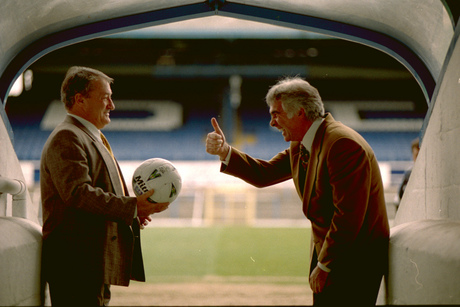
If ever you wanted justification of my oft repeated claim that the quality of managers at Cardiff since 1963 has been very poor, then it has to be the fact that I have had to include him in my top ten. Gould gets in solely because of him being the person who recommended that we bring the likes of Danny Gabbidon, Graham Kavanagh, Peter Thorne, Neil Alexander and Rhys Weston (who were all regulars in the side playing two divisions higher than Gould’s three years later) to the club. His signing of the ungainly, but effective Leo Fortune-West was also something to be put in his plus column, but, in all honesty, someone with a record like his should not be anywhere near a manager’s top ten when you have got nearly half a century’s worth of candidates to choose from – have a look at the ones who missed out on the top ten and tell me who should be in there in his place though?
9. Alan Cork
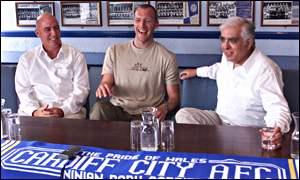
The dream team - Alan Cork, Spencer Prior and Sam Hammam.
With his monosyllabic media appearances and his reputation as a long ball merchant, Alan Cork was never able to fully win over City fans. It’s also true to say that the vast majority of the crazy spending that was to bring the club to it’s knees in 2005, was done under Cork’s watch and not all of those big money transfers could be judged as successes either. However, it would be unfair to blame Alan Cork entirely for all of this and, all things considered, he wasn’t too bad a City manager really. He took over in late September 2000 when our season was going nowhere, but transformed it completely by using a three centreback system which revived Andy Legg’s career as he made a great success of the sweeper role he was given – City were also the highest scoring team in the country that season. It shouldn’t be forgotten either that Alan Cork was in charge for that epic FA Cup win over Leeds in January 2002, but it didn’t do him much good because he was out of a job within five weeks after his expensive, but inconsistent, team were thumped 4-0 at Wigan.
8. Jimmy Andrews
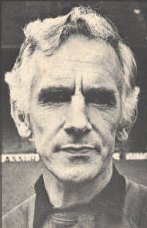
Jimmy Andrews - too nice to be a manager?
Jimmy Andrews owes his place in the top ten solely to the entertaining promotion team of 1975/76. That side always tried to play good, and attacking football and certainly didn’t buckle when the pressure came on at the end of that campaign as they produced a run of six wins and three draws from their final nine matches whilst conceding just one goal in the process. Andrews’ signing of Tony Evans has to be a contender for City’s best free transfer capture ever, with his partnership with Adrian Alston being one of the most potent I have seen at the club and the likes of Alan Campbell and Mike England were also shrewd signings who brought know how and craft to a side low on confidence following their relegation to the third tier a season earlier. However, although Andrews stuck by his attacking principles, it was struggle all the way besides that. A lot of the good work in the transfer market a few years earlier was undone by his failure to utilise the managerial and coaching talents of England and John Toshack and the disastrous signing of Mickey Burns as player/coach and it was no surprise when he was eventually sacked in October 1978.
7. Richie Morgan
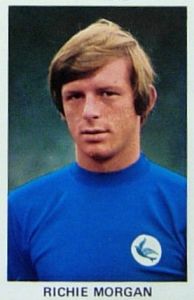
Richie Morgan, under rated as a player and a manager.
I can remember Richie Morgan’s appointment as full time manager (he had initially been given the job on a caretaker basis after Jimmy Andrews’ sacking) being greeted with little enthusiasm and there wasn’t much in his early results to suggest that he could drag the team out of their 1978/79 relegation struggle. However, Morgan used a cold snap that saw us play just one game between 30 December and 24 February well and by the time the team returned to action it was with a remodeled team that featured teenager Lindon Jones at right back and new signings Colin Sullivan and Ronnie Moore at left back and centre forward respectively. The changes worked and City finished the season in great form as a run of eleven unbeaten games saw them finish in the giddy heights of ninth position! Moore, the striker who couldn’t score, rather typified Richie Morgan’s dour but effective teams – there weren’t many goals around in 79/80, but at least it was a mid table season when relegation was never a serious possibility. After being given a fair bit of money to spend during his early days at the club, the usual restrictions were placed on him from 1980 onwards and, predictably, City struggled – it was still a surprise though when in November 1981, he was “moved upstairs” to become general manager while Graham Williams took charge of team affairs. Williams’ appointment was a disaster and he was gone within three months as City headed for relegation – it’s still something of a mystery though as to why Morgan had to be sacked with him.
6. Eddie May
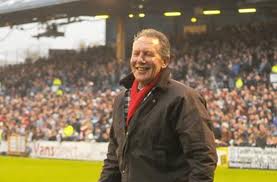
Eddie May, one of only two City managers to win a Championship since the club were elected to the Football League, seen making a return to Ninian Park in 2008/09.
I think there may be quite a few City fans who will think that Eddie May deserves a higher place than number six. My reason for doing that though is that, just like Alan Cork, Eddie May was given an awful lot of money to spend for a manager in charge of a team in the Football League’s basement. May was given a substantial transfer budget in his first season (91/92), but, although Carl Dale and Paul Ramsey were excellent signings, Paul Millar a decent one and the loan signings of Eddie Newton and Gerry Harrison were the catalyst for a good run in early 1992, City didn’t even make the Play Offs despite playing some fine football at times. May got it right second time around though as a more physical and experienced team featuring the likes of Robbie James, Nicky Richardson, Derek Brazil, Phil Stant and Kevin Ratcliffe deservedly won the Third Division (old Fourth Division) title and retained the Welsh Cup. With owner Rick Wright pulling the plug as far transfer funding went, 1993/94 was always going to be a tough season at the higher level and May’s feat of steering the side to a safe, lower mid table position while also beating Middlesbrough and Man City in a run to the Fifth Round of the FA Cup was, arguably, just as impressive as what he had achieved twelve months earlier. However, May never looked like staying long under the newly installed Jim Cadman consortium and he left in November 1994 with City struggling badly, only to return for the last few weeks of the campaign with relegation virtually assured – it was a sad and anti climactic end at Cardiff for someone who always had a pretty good rapport with the fans.
5. Lennie Lawrence
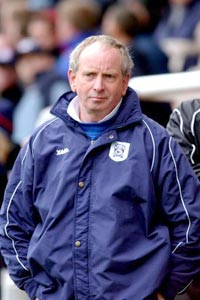
Lennie Lawrence, sacked for keeping his hands in his pockets?
Again, there may be some who feel Lennie should be higher than fifth, but the job becomes that much easier if you have the sort of money he had to spend in the third tier of the domestic game. Lawrence made an immediate impact when he took over from Alan Cork in February 2002 and City went on an excellent run which saw them reach the Play Offs before agonisingly being beaten at home by Stoke having won the first leg at the Britannia Stadium. With expensive new signings Andy Campbell and Chris Barker added to the squad as well as influential midfielder Gareth Whalley on a free, City started 02/03 in fine form, but from the end of October onwards they lacked consistency, struggling particularly in home matches where expectation levels were sky high. City scraped into the Play Offs in sixth place, but to Lawrence’s credit, he got the team defending well at just the right time as promotion was obtained without a goal being conceded in those last three, high pressure, games. I always thought of Lennie Lawrence as a pretty cautious manager and so it was a big surprise to see City playing such good attacking football for much of their first campaign in the second tier in eighteen years. Money problems were beginning to grip the club again though and so it was free transfers and loanees for most of the time as 04/05 turned into a relegation scrap, which City survived by reaching safety in their penultimate game – it was not enough to save Lawrence his job though as the experienced manager who never really won over the supporters left the club in May 2005.
4. Len Ashurst
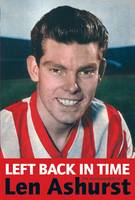
Len Ashurst - more appearances for Sunderland than any other outfield player (if only we'd had a left back half as good as him last season).
Len Ashurst managed the promotion Lennie Lawrence did, but with a shoestring budget. Arriving in March 1982, Len Ashurst’s first home match in charge was a remarkable 5-4 win over Cambridge United, but, although there were some other notable wins for him at Ninian Park, he couldn’t prevent a relegation that had been on the cards for much of the campaign. During the summer, the team was completely rebuilt with free transfer signings galore and to general surprise, City were able to win back their Second Division status at the first attempt on the back of Jeff Hemmerman’s goals. Very much a member of the old school in his management approach, Ashurst fell out with a few players (e.g. Keith Pontin and Billy Woof) and left the talented Dave Bennett out at times if he thought he wasn’t pulling his weight, but the winger cum striker’s’ skills were a vital part of a successful team as the manager also coaxed some great performances at centreback out of Phil Dwyer whose City career had looked over a few months earlier. Forced to rebuild his side for life back at the higher level after the loss, for various reasons, of his three main goalscorers, City hardly surprisingly, were not prolific in front of goal in 83/84, but Gordon Owen was another excellent free signing and he gave City enough of a cutting edge to make sure the team stayed comfortably above the drop zone. Given the job he had done at Cardiff, it was no surprise that a top level team picked Ashurst up as his former club Sunderland appointed him in place of Alan Durban in March 1984.
Len Ashurst wasn’t finished with City though as he returned for a second, less successful, spell in charge in August 1989. Ironically, Ashurst was given the transfer funding that he never saw in the early 80’s this time around, but, apart from Cohen Griffith who gave the club years of good service, his buys were not successes and it was free transfer signings like Chris Pike and Gavin Ward that were more notable. City were a poor side that season and were relegated with barely a whimper of resistance at Bury on the final day of the campaign. With the club’s finances now probably in as precarious a state as they have ever been, there was no immediate promotion this time. In fact, 90/91 proved to be a tough season as Ashurst seemed unable to inspire a young side out of a mid table rut and, probably seeing that the writing was on the wall for him, one of the better City managers I have seen quit the club as soon as the campaign finished.
3. Frank Burrows
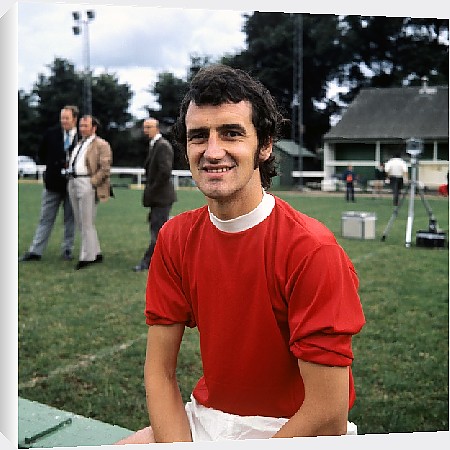
Frank Burrows - hard and uncompromising both on and off the pitch.
As the only manager to achieve two promotions at Cardiff in my time, Frank Burrows deserves a place in the top three. Burrows took over for the first time in the summer of 1986 with the club facing their first ever season in the league’s basement. With little money available, 86/87 turned into something of a holding operation, but Burrows demonstrated his knack of finding cheap but good players by signing Terry Boyle, Paul Wimbleton, Nicky Platneaur and Kevin Bartlett with the latter three bringing in much needed revenue when they moved on a few years later. In his second season though, promotion always looked on the cards as bargain buy Jimmy Gilligan supplied the goals and Alan Curtis the class that had been previously lacking – there was the added bonus of a Welsh Cup win courtesy of a 2-0 win over Wrexham at the Vetch Field as well. City comfortably survived at the higher level the following season, but the pressure to sell was always present and when many of the team’s stalwarts moved on in the summer of 1989, Frank Burrows wasn’t far behind them as he left to join Second Division Portsmouth as their new boss.
Just as with Len Ashurst and Eddie May though, there was a second spell at Cardiff for Frank Burrows as he was brought back in February 1998 to replace Russell Osman. Burrows was unable to do anything to turn around the fortunes of one of the worst ever City sides as the team suffered the ignominy of finishing in the league’s bottom four, but he put things right with a vengeance the following year. Fine signings like Mark Delaney, John Williams, Graham Mitchell, Richard Carpenter and the on loan Matt Brazier meant that City were always challenging near the top and with Kevin Nugent recovered from the injury that had kept him out for much of the previous season, City enjoyed a tremendous spell either side of Christmas with a series of high scoring wins at Ninian Park. Life became more of a struggle after the superb Delaney left, but Burrows again did well in the transfer market to recruit Jason Bowen and Andy Legg from Reading on frees and promotion was assured after a tense goalless draw with Scunthorpe at Ninian Park. With a new Board in place and a bit of money to spend, there was much optimism that City could make an impact in the higher league, but Burrows’ three centre back system that had worked so well the previous year was a flop this time as the team played some good football, but struggled to win games at home. Despite plenty of new recruits, City were unable to climb clear of the relegation zone and Frank Burrows’ time at Cardiff ended with a truly dismal 3-1 home defeat to Luton in January as he resigned his post despite attempts by Chairman Steve Borley to get him to stay.
2. Dave Jones
- Dave Jones with Norwich manager Paul Lambert, one of three men who, indirectly, got him the sack, after the 1-1 draw at Carrow Road in January.
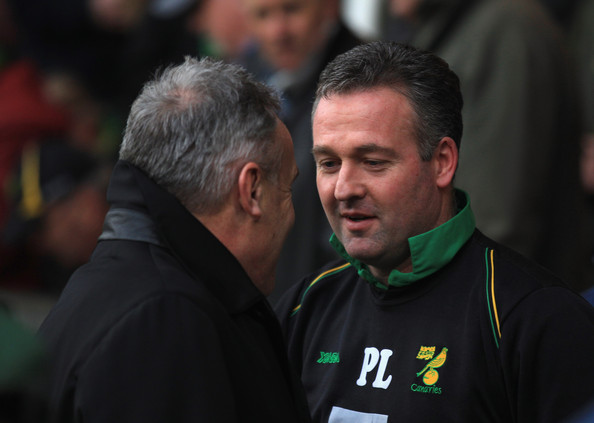
Dave Jones would have been number one in this list if he had left his job at the end of the 2009/10 campaign, but, for me, so much of his earlier good work was undone over the course of the season just ended when a series of poor signings, strange tactical and selection decisions and an increasingly morose and sour public demeanour all played their part in dowsing down optimism and positivity at the club. Allowances had to be made for all that the man had gone through after his loss of the Southampton job of course, but that could only go so far and it was only after the season had finished that it really hit home how bad things had got at Cardiff as far as the “feel” of the club went. Therefore, it’s worth bearing in mind that emotions are still raw as far as our former manager is concerned at the moment and it’s probably difficult to be totally objective in analysing just how good or bad a manager Dave Jones was for us.
He was the man who nearly took us to the Premiership but the nature of those failures pointed to weaknesses at the heart of his teams and, possibly, the man himself. There are two sides to every story though and it has to be noted that many of the criticisms I have outlined here have come about because I’m applying standards to Dave Jones that I haven’t been to eighteen of the others involved in this process – only Dave Jones and the man who finished above him in my top ten have been able to say that they were in charge of teams realistically chasing promotion to the top flight. As I hinted above, the passing of time might well see Dave Jones’ merits being reassessed by Cardiff fans – for example, if the club goes into a decline now, then, surely, he has to be credited more for the three top seven finishes and FA Cup Final appearance we have seen over the past four seasons, but, if, say, Malky Mackay were to get us promoted to the Premiership during his time with us, then his reputation as the “nearly man” would be reinforced.
1. Jimmy Scoular
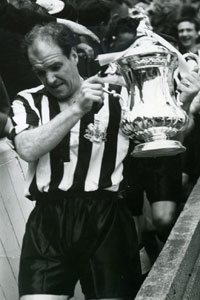
- Jimmy Scoular after being presented with the FA Cup following Newcastle’s 3-1 win over Manchester City in the 1955 Final.
So was Jimmy Scoular really as good as us old fogeys make him out to be or are we all wearing those rose tinted spectacles that distort so many of the images from your youth? Well, when you look at a record that showed only three seasons out of nine where City challenged for a place in the top flight against four when we were in serious relegation trouble (we were nearer the bottom of the league than the top in his two other seasons with us well) and a pretty ordinary win percentage rate then I can certainly see why younger fans would look at his record and ask what all the fuss was about. What I would say to that is, despite the common perception that we are always skint, there have been times during the past half a century when some City managers have had some serious financial backing – Jimmy Scoular was not one of them. This point is probably best illustrated by what happened after the sale of John Toshack to Liverpool in November 1970 for £110,000. With City second in the table at the time and averaging more than 20,000 per game, you would have thought that much of that money would have been made available to Scoular for the replacement striker we definitely needed. Instead of that though, the Board balked at making less than half of that available to him for six weeks and vital games were lost before they finally relented and agreed to pay £42,000 for the Sheffield Wednesday striker Alan Warboys – if Scoular had been given the backing that some in this list have had, I think there is every chance that we would been playing First Division football in 1971/72.
One of my criteria in picking this top ten has been that the men who gave us a realistic chance of playing top level football have to be numbers one and two, but, even allowing for the criticisms of him I outlined above, Dave Jones’ record looks a better one than Jimmy Scoular’s. The Scot’s achievement in getting us to two Quarter Finals and one Semi Final of the European Cup Winners Cup is cancelled out for me by the FA Cup Final appearance in 2008 and the fact that Dave Jones’ Cardiff teams were decent cup performers during his time with us, so why go for Scoular as number one? I think the best way of answering that is to refer back to the way that five of his former players talked about him at the Supporter’s Trust do on 10 June at the Duke of Clarence. Jimmy Scoular was a competitive player (my parents would replace “competitve” with “dirty” if they were still around mind!) and he certainly didn’t suffer fools gladly – I think all of the players involved told at least one story about being on the wrong end of a Scoular rant. However, I got the distinct impression that all five players would have run through a wall for Jimmy Scoular such was the respect and, I think, affection, they had for a man for whom nothing was too much for his team. Yes, times are different now and attitudes have changed, but, certainly last season, you got the impression there were some in the Cardiff team who were not prepared to break even a finger nail for Dave Jones!